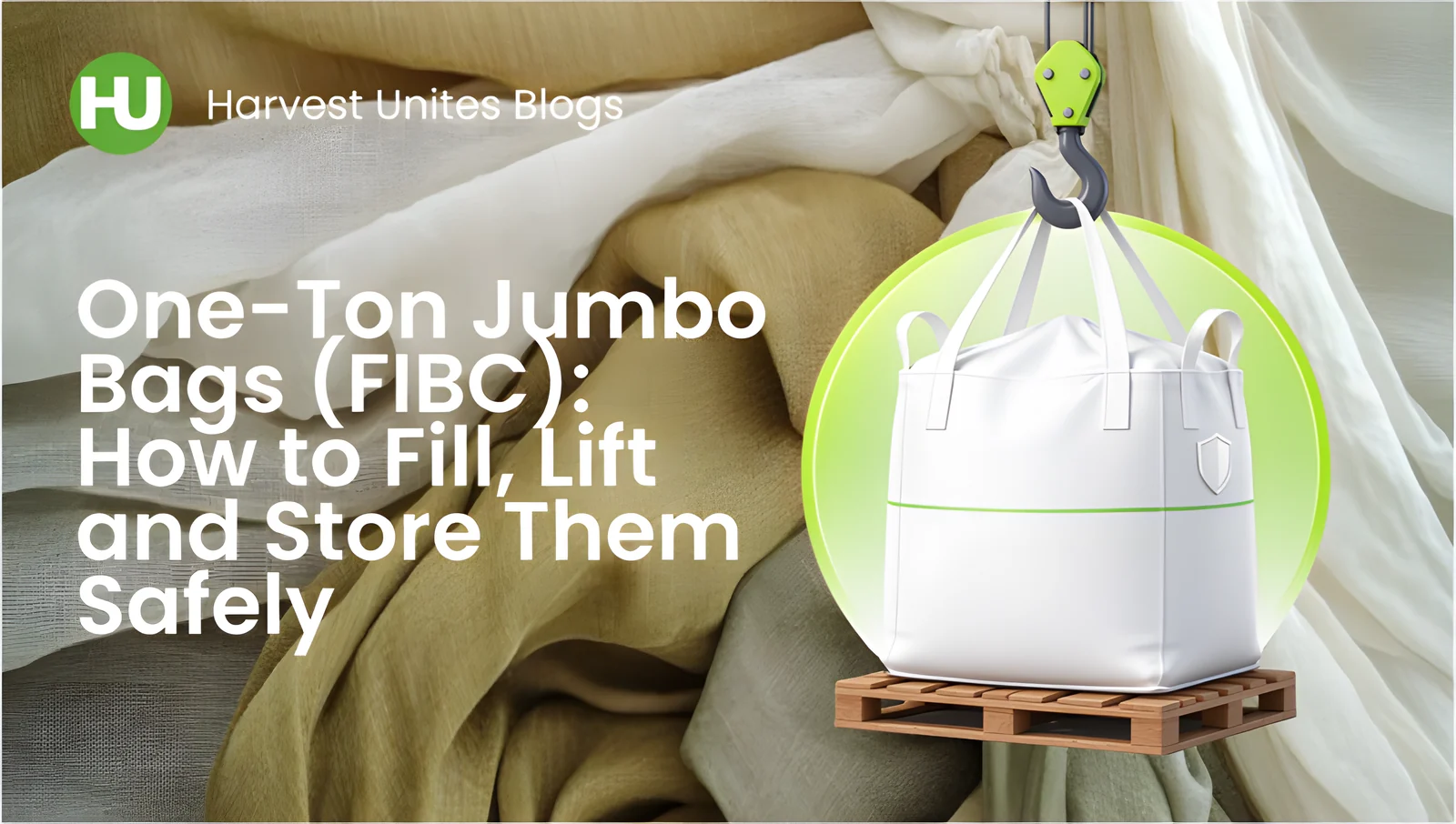
From sand and aggregates on construction sites to resin pellets, fertiliser and recycled materials in factories, the one-ton jumbo bag has become one of the most efficient ways to move bulk goods in Malaysia. A single bag can replace dozens of small sacks and be handled in one forklift movement. But a full jumbo bag can weigh well over a tonne, and that weight demands respect. A torn loop, a badly balanced load or a careless lift can damage stock, equipment and, most seriously, people.
This guide explains how to fill, lift, move and store jumbo bags (also called FIBCs, bulk bags or tonne bags) safely. It covers load ratings and the idea of a safety factor, what to check before every use, correct filling and lifting practice, stacking and storage in Malaysia's hot and humid conditions, and when a used bag should be retired instead of reused.
What Is a One-Ton Jumbo Bag (FIBC)?
FIBC stands for flexible intermediate bulk container. It is a large, foldable container sewn from woven polypropylene fabric, with lifting loops at the top corners so it can be picked up by a forklift, crane or hoist. When empty it folds flat and weighs very little; when filled it stands as a stable block that holds a large volume of dry, flowable material.
As a reference point, the standard one-ton jumbo bags supplied by Harvest Unites from our Ipoh warehouse have the following specifications:
- Height: 1100 mm ± 10 mm
- Width: 900 mm ± 8 mm
- Side gusset: 300 mm ± 5 mm
- Tare weight: 750 g ± 50 g
- Maximum bearing weight: 1200 kg
- Material: heavy-duty virgin PP woven fabric
Jumbo bags are made from the same basic material as ordinary sacks, only heavier and stronger. If you want to understand how woven polypropylene fabric gets its strength, our guide to PP woven bag types and uses explains the process in detail.
Understanding Load Ratings and the Safety Factor
Every jumbo bag has a maximum load it is designed to carry, often called its safe working load (SWL). This is the heaviest weight of product the bag should hold during normal filling, lifting, transport and storage. It is not a target to aim for, and it is certainly not a figure to stretch "just this once".
Manufacturers design bags with a safety factor, which means the bag is built to withstand a load several times heavier than its rated SWL during testing before it fails. The safety factor is often expressed as a ratio, such as 5:1 for bags intended for a single trip and 6:1 for bags designed for repeated use. The margin exists to cover real-world stresses that a static number cannot capture:
- Dynamic loads: a bag that swings, jolts over a pothole or is braked suddenly on a forklift experiences forces much higher than its static weight.
- Uneven loading: if one loop carries more weight than the others, that loop and its stitching are stressed far beyond an even share.
- Material ageing: sunlight, abrasion, heat and repeated use all weaken polypropylene over time.
- Small manufacturing variations: fabric weight, stitching and loop attachment are never perfectly identical from bag to bag.
The key lesson is simple: the safety factor is there to protect people from the unexpected, not to give you extra capacity. Always read the label or specification for the bag in front of you, never fill beyond its rated load, and treat any bag without a clear rating with caution. For a standard Harvest Unites jumbo bag, the maximum bearing weight is 1200 kg, and the weight of your product, not just its volume, must stay within that limit.
Inspect Before Every Use
A quick visual check before filling takes less than a minute and is the single most effective way to prevent bag failure. This applies to new bags and is absolutely essential for used ones. Lay the empty bag out on a clean surface and check:
- Lifting loops: look for cuts, fraying, burns, knots or stretched fibres, and make sure every loop is firmly attached.
- Loop stitching: the seams joining the loops to the body take the full load during lifting. Broken or loose stitches are a reason to reject the bag.
- Body fabric: check for holes, tears, worn patches and areas where the weave has become brittle or faded.
- Base and side seams: confirm the seams are continuous and not separating.
- Spouts and closures: if the bag has a filling or discharge spout, make sure ties are present and the spout fabric is intact.
- Contamination: make sure the bag is clean, dry and free of residue that could react with or spoil your product.
If a bag fails any of these checks, do not use it for lifting. Set it aside, mark it clearly so no one picks it up by mistake, and replace it.
How to Fill a Jumbo Bag Safely
Correct filling makes every later step safer. A bag that is filled evenly sits upright, distributes its weight across all loops and stacks predictably. A bag that is overfilled, lopsided or loosely packed becomes unstable the moment it leaves the ground.
Follow these steps when filling:
- Support the bag properly. Hang the loops on a filling frame or forklift tines, or stand the bag on a pallet, so it opens fully and keeps its shape while product goes in. Never ask a worker to hold the bag open by hand under a running chute.
- Place it where it will be lifted from. Filling on a pallet lets you move the full bag by forklift without needing to lift it by its loops at all.
- Fill gradually and centrally. Direct the product into the middle of the bag so it settles evenly and the bag does not lean.
- Settle the contents. For powders and granules, gentle vibration or pausing to let material settle helps the bag form a firm, square shape.
- Weigh, do not guess. Use a scale or a load cell on the filling frame to confirm the filled weight is within the rated load. Dense materials such as sand can reach the weight limit long before the bag looks full.
- Close securely. Tie off the filling spout or close the top cover so product cannot spill during lifting and transport.
- Label the bag. Mark the contents, weight and date so handlers know what they are lifting.
Keep the area around the filling station clean and well lit. Spilled granules and powders make floors slippery, and dust from fine products may require masks and good ventilation.
Lifting and Moving Jumbo Bags
Lifting is the highest-risk moment in a jumbo bag's life. The rules below should be part of every operator's training and should never be relaxed for speed.
Lifting with a Forklift
Use forklift tines that are smooth and rounded at the edges, because sharp or damaged tines can cut lifting loops. Adjust the tines so the loops hang vertically, and place all loops over the tines. Lift smoothly, keep the load as low as practical while travelling, and avoid sudden braking, sharp turns and rough ground. The forklift should be rated for the full weight of the bag.
Lifting with a Crane or Hoist
Use a hook, bar or lifting frame designed for bulk bags, with rounded surfaces that will not cut into the loops. Make sure the loops sit evenly and are not twisted, and that the hook is centred above the bag so it lifts straight up rather than swinging or dragging.
Whatever equipment you use, these rules always apply:
- Use all the loops. Lifting by one or two loops concentrates the full weight on a fraction of the bag's design strength.
- Never stand under a suspended load. Keep everyone clear of the area beneath and around a lifted bag, including the operator.
- Never put hands inside or under a raised bag to adjust it, open a discharge spout or steady it.
- Do not drag or push bags with the forklift; abrasion damages the base fabric.
- Lift vertically and smoothly, without jerking or swinging the load.
- Do not lift bags that are wet, damaged or showing signs of leakage by their loops; move them on a pallet instead.
When transporting bags by lorry, place them on a flat, clean deck free of nails and sharp edges, load them tightly together so they cannot shift, and secure them with suitable straps. Avoid overhanging loads and protect bag edges where straps press against them.
Storing and Stacking Jumbo Bags
Good storage protects both the product inside and the people working nearby. Filled jumbo bags are heavy and, unlike rigid containers, can slump or lean over time. Before stacking, make sure your bags are designed and filled for it: a bag that bulges, leans or has settled unevenly should not support another bag.
Practical storage guidelines:
- Store on pallets, not bare floor. Pallets keep bags off damp concrete, reduce abrasion and make forklift handling easier. Sturdy wooden pallets suit general warehouse work, while plastic pallets resist moisture and suit hygiene-sensitive products.
- Use a firm, level floor. Uneven ground causes stacks to lean and can trigger a collapse.
- Stack only stable, well-filled bags, placing each upper bag squarely over the one below, with its weight centred.
- Keep stacks low. Follow your site's safe stacking height and reduce it for loose-flowing or soft-sided loads.
- Leave clear aisles for forklifts and pedestrians, and keep people away from stacks while bags are being placed or removed.
- Pyramid outer rows where possible so the edge of a stack is supported and less likely to topple.
Pallet capacity matters too. The standard wooden pallets we supply carry up to 1000 kg while being moved and up to 3000 kg in static storage, and our plastic pallets carry up to 1500 kg dynamic and 4000 kg static. Always match the pallet to the filled weight of the bag, and remember that dynamic limits apply whenever the pallet is being lifted. Our guide on storing and transporting with wooden pallets covers pallet care in more detail.
Protecting Bags from Sun, Heat and Rain
Polypropylene is strong, but it is weakened by ultraviolet light. In Malaysia's strong sun, bags left outdoors for long periods can become brittle, fade and lose strength, especially at the loops. Store filled and empty bags indoors or under cover wherever possible. If outdoor storage cannot be avoided, cover the bags with tarpaulin, keep the storage period short, and inspect them carefully before lifting. Covering also keeps rainwater out, because a woven bag is not waterproof and moisture can spoil products such as fertiliser, cement and feed.
Reusing Used Jumbo Bags Responsibly
Used jumbo bags are a cost-effective and more sustainable option for construction, recycling and waste handling. Reuse is sensible, but only when the bag is still fit for the job. Before refilling a used bag:
- Check its history if you can. Do not use a bag that previously held chemicals or hazardous materials for food, feed or incompatible products.
- Inspect it fully, using the same checklist as for a new bag, paying extra attention to loops and stitching.
- Consider reducing the fill weight for bags that show general wear, and match the bag to lighter-duty tasks.
- Clean and dry the bag before refilling, and empty out any residue.
- Retire bags with damaged loops, torn fabric or signs of UV degradation. They can still be sent for plastic recycling rather than landfill.
For food-related and first-use applications, choose new bags. Used bags are best kept for construction materials, scrap, recycling and similar duties where hygiene requirements are lower.
Frequently Asked Questions
How much can a one-ton jumbo bag hold?
It depends on the bag's rating. The standard jumbo bag supplied by Harvest Unites has a maximum bearing weight of 1200 kg. Always check the weight of your product, not just its volume, because dense materials such as sand reach the weight limit before the bag looks full.
Can I lift a jumbo bag using only two loops?
No. A bag designed with four lifting loops should be lifted using all four. Lifting with fewer loops puts the whole weight on part of the bag's structure and greatly increases the risk of a loop tearing or the bag failing.
How long can jumbo bags be stored outdoors?
As short a time as possible. Sunlight gradually weakens polypropylene, so bags should be stored indoors or under cover. Any bag that has been outdoors for a long period should be inspected carefully, especially the loops, before it is lifted.
Is it safe to reuse a jumbo bag?
Many jumbo bags can be reused for suitable loads, provided they pass a full inspection of the loops, seams and fabric, are clean, and are never filled beyond their rated load. Damaged or sun-degraded bags should be retired.
Key Takeaways
Jumbo bags save time, labour and packaging, but only when they are handled with care. Know the rated load of each bag and respect it, inspect every bag before filling, fill evenly and weigh the result, lift using all loops with suitable equipment, and never allow anyone to stand under a suspended load. Store bags on pallets, under cover and in stable, low stacks to protect both your product and your team.
Harvest Unites has supplied industrial packaging from Ipoh, Perak since 2009, including new and used jumbo bags and the pallets to go with them. If you are unsure whether a new or used bag suits your material, tell us what you are packing and how you plan to handle it, and our team will help you choose the right option.