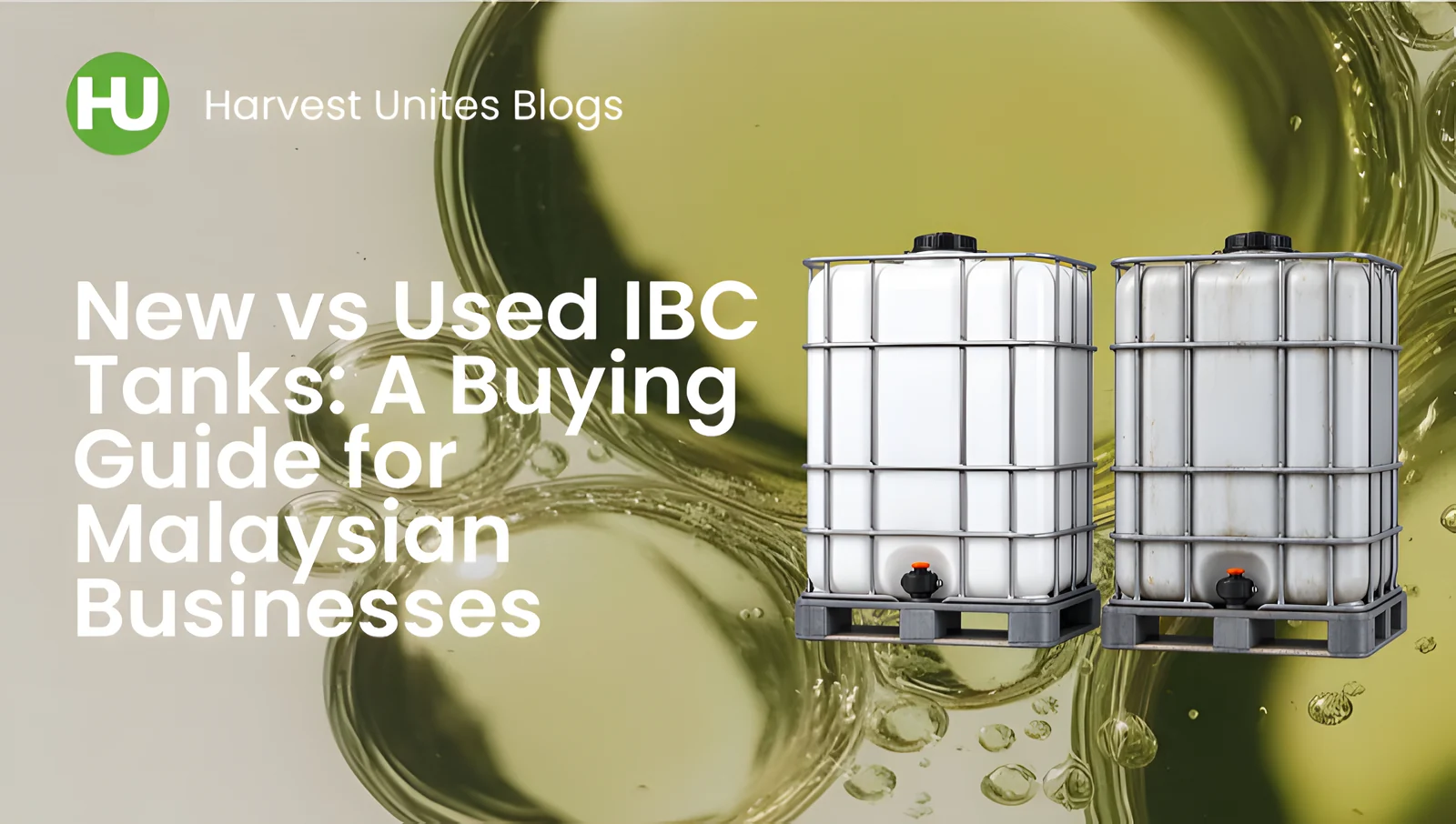
The 1000 litre IBC tank has become a familiar sight across Malaysia, from palm oil mills and fertiliser stores to food processing plants, car workshops and small farms. It stores and moves liquids in one compact unit, it drains through a bottom valve, and it fits neatly onto a lorry or into a warehouse corner. When the time comes to buy, though, most businesses face the same question: should we pay for a new tank, or save money with a used one?
There is no single right answer. A new tank is the safe choice for food and sensitive products, while a used tank can be excellent value for water, cleaning liquids and other non-food uses. This guide explains how IBC tanks are built, where new and used tanks each make sense, how to check previous contents and inspect a used tank, and how to store and handle IBCs in Malaysian conditions, so you can buy with confidence.
What Is an IBC Tank?
An IBC, or intermediate bulk container, is a plastic inner tank held inside a steel cage that sits on an integrated pallet base. One tank holds as much liquid as five 200 litre drums, yet it needs only one forklift movement and takes up less floor space. Liquid is filled through a large opening at the top and drawn off through a valve at the bottom.
The IBC tanks supplied by Harvest Unites from our Ipoh warehouse share these specifications, whether new or used:
- Inner tank capacity: 1000 litre ± 5 L
- Base footprint: 1200 mm × 1000 mm (± 5 mm)
- Height: 1150 mm ± 5 mm
- Tare weight: 58 kg ± 3 kg
- Top inlet: 150 mm ± 3 mm diameter
- Outlet: 50 mm standard drain valve
- Colour: natural white inner tank with a silver metal frame
Because the base matches the common 1200 × 1000 mm pallet size, an IBC fits the same racking, lorry beds and floor plans that many Malaysian warehouses already use for palletised goods.
New IBC Tanks: When They Make Sense
A new IBC tank has never held any product. You know exactly what has touched the inside, the valve and seals have not been worn by previous use, and the frame has not been knocked around in somebody else's yard. That certainty is what you pay for.
Choose a new tank when:
- You handle food ingredients: syrups, edible oils, sauces and other food products should only go into new, food-compatible tanks. A used tank cannot give the same assurance about what it held before.
- Product purity matters: some liquids react with traces of other chemicals or are easily contaminated, for example certain cosmetic, pharmaceutical or laboratory inputs.
- Your customers see the packaging: if the tank is delivered to a customer along with the product, a clean new unit reflects better on your brand.
- You need a long service life: a new tank starts with a full working life, which suits operations that plan to refill the same tanks many times.
- Your customer or auditor specifies new containers: some buyers and quality systems require them, so check your contracts before deciding.
The trade-off is cost. New tanks cost more upfront, and for many applications that extra assurance simply is not needed.
Used IBC Tanks: Where They Offer Value
A used IBC tank has already completed at least one trip, usually carrying an industrial or commercial liquid. Harvest Unites supplies used, cleaned tanks as a practical low-cost option. For the right application, a used tank does the job just as well as a new one at a lower price.
Used tanks are well suited to:
- Water storage: backup water on construction sites, factories and farms, or water for washing and cooling.
- Rainwater harvesting: a popular use in Perak's wet climate, collecting roof run-off for gardening, washing vehicles or cleaning floors.
- Agricultural inputs: liquid fertiliser and other farm liquids, as long as the previous contents are compatible.
- Detergents, oils and industrial liquids: general non-food liquids for workshops and factories.
- Internal transfer and storage: tanks that stay inside your own premises and never reach a customer.
Reusing a sound tank also keeps it in service longer instead of sending it for disposal, which supports the kind of approach described in our article on sustainable industrial packaging in Malaysia.
Check Previous Contents and Compatibility First
The most important rule with any used IBC tank is simple: know what it held before, and make sure that history is compatible with what you plan to put in it. Plastic can absorb small traces of some substances, and cleaning reduces residue but cannot always guarantee that every trace is gone.
Before you commit to a used tank, work through these steps:
- Ask about previous contents: your supplier should be able to tell you the general category of product the tank carried.
- Match it to your use: a tank that held a mild detergent may be fine for another cleaning liquid, but not for something that reacts with detergent residue.
- Never use ex-chemical tanks for food, feed or drinking water: if a tank held hazardous chemicals, it should not be used for anything people or animals will consume.
- Check the label and markings: look for any remaining labels or hazard markings on the tank and cage, and remove old labels once you have confirmed the history so that nobody is misled later.
- Confirm suitability for chemicals: if you plan to store a chemical, check the product's safety data sheet to make sure the tank material and valve seals are suitable.
- When in doubt, choose new: if the history is unclear and your product is sensitive, the savings are not worth the risk.
How to Inspect a Used IBC Tank Before Buying
Even a well-cleaned tank should be inspected before it goes into service. If you can, view the tanks at the supplier's yard, or ask for clear photos before delivery. Check the following:
- Inner tank: look for cracks, deep scratches, bulges or soft spots. Shine a torch through the top inlet to check for remaining residue, discolouration or odour.
- Steel cage: bars should be straight and firmly welded, with no broken joints. Light surface marks are normal, but heavy rust or bent bars weaken the frame.
- Pallet base: check that the base is level and undamaged, so forklift tines can enter safely and the tank sits flat.
- Drain valve: open and close the 50 mm drain valve to confirm it turns smoothly and seals fully. Check the gasket for cracks or hardening.
- Top lid: make sure the 150 mm lid screws on properly and its seal is intact.
- Leak test: fill the tank with clean water and leave it overnight before using it for your actual product. Check the valve, seams and base the next morning.
A tank that passes these checks is ready for compatible use. A tank with a cracked inner bottle or a weakened cage should be rejected, however attractive the price.
Handling and Storage in Malaysian Conditions
Malaysia's heat, humidity, strong sunlight and heavy rain all affect how long an IBC tank lasts and how safely it performs. A filled tank weighs around a tonne, so good handling matters as much as the tank itself.
- Keep tanks out of direct sun where possible: long exposure to sunlight can weaken plastic over time and may encourage algae growth in water. Store tanks under a roof or cover them with an opaque sheet.
- Use a firm, level base: place tanks on a concrete floor or a solid platform. Soft ground can settle unevenly during heavy rain and tilt the tank.
- Protect the steel frame: in humid conditions the cage can rust, especially near the coast or in wet yards. Keep the base off standing water.
- Lift with the right equipment: only move a filled tank with a forklift or pallet jack rated for the load, with the tines fully under the base.
- Stack with care: only stack tanks if they are designed and rated for it, never stack damaged tanks, and keep the valve accessible.
- Label clearly: mark every tank with its current contents and fill date, particularly in sites that store several different liquids.
- Plan for spills: keep absorbent material nearby, and consider bunding or a spill tray for oils and chemicals.
The same principles apply to drums and pallets. Our guide to wooden pallets and industrial drums covers stacking, forklift handling and inspection in more detail.
IBC Tanks vs 220 Litre Drums
Many businesses that ask about IBC tanks are moving up from drums. Both containers have their place, and many sites use a mix of the two.
- Volume: one 1000 litre IBC holds about as much as five 200 litre drums, so it suits high-volume liquids.
- Handling: an IBC is moved in one forklift trip, while drums are usually moved four at a time on a pallet.
- Discharge: an IBC drains by gravity through its bottom valve; drums usually need a pump or tilting.
- Batch size: drums are better for smaller batches, several different products, or customers who buy in smaller quantities.
- Food use: our blue 220 litre HDPE plastic drums are made from food-grade virgin HDPE, and new drums are suitable for food products.
If you still use drums, place them on a sturdy pallet such as our 1200 × 1000 mm wooden pallets, which carry up to 1000 kg while moving and 3000 kg when stored. For wet or hygienic areas, plastic pallets rated for 1500 kg dynamic and 4000 kg static loads are an alternative.
Frequently Asked Questions
Can I use a used IBC tank for drinking water?
We do not recommend it unless you are certain the tank only ever held food-grade or potable contents. For drinking water and food products, choose a new, food-compatible tank. Used tanks are best for non-potable water such as washing, cooling, irrigation and rainwater collection.
How much does an empty IBC tank weigh?
Our IBC tanks have a tare weight of 58 kg ± 3 kg. When filled with 1000 litres of water, the total weight is about one tonne, so always use a forklift or pallet jack rated for the load.
What size is the drain valve?
The tanks have a 50 mm standard drain valve at the bottom and a 150 mm inlet at the top. Check that your hoses and fittings match the valve before installation.
Are used IBC tanks cleaned before sale?
Harvest Unites supplies used, cleaned IBC tanks. Cleaning reduces residue, but you should still confirm that the previous contents are compatible with your intended use and inspect the tank before filling it.
Key Takeaways
Choose a new IBC tank for food, drinking water, sensitive products and customer-facing deliveries, where certainty about the tank's history matters most. Choose a used, cleaned tank for water storage, rainwater harvesting, agricultural liquids, detergents and other non-food uses, where it delivers the same capacity and handling benefits at a lower cost. In every case, confirm previous contents, inspect the tank and run a water test before use.
Harvest Unites has supplied industrial packaging from Ipoh, Perak since 2009, and we stock both new and used 1000 litre IBC tanks alongside drums and pallets. If you are unsure which option suits your product, tell us what you plan to store and how much you need, and our team will help you choose.